I spent 12 years listening through studio monitors in Nashville control rooms, and I learned one useful lesson: high end speakers are not automatically good speakers. Some are beautifully engineered tools that reveal texture, timing, and distortion without making music exhausting. Others are expensive furniture with a treble peak and a persuasive brochure. This guide explains where the money should go, what measurements matter, and how to choose a system that sounds right in your actual room.
What “high end” should mean
There is no official price line that turns a speaker into high end speakers. A $2,000 pair can outperform a $20,000 pair in the wrong room, while a carefully designed $600 bookshelf model can embarrass a fashionable tower. I use the term for products that combine strong engineering, consistent manufacturing, useful dynamics, and a design intended to serve music rather than impress a showroom visitor.
The important question is not whether a cabinet uses exotic wood or a tweeter has a dramatic name. Ask whether the speaker produces a smooth frequency response, low distortion at realistic volume, controlled directivity, and enough bass for your room. Frequency response describes the balance from bass to treble. A speaker with a large treble rise sounds bright, meaning cymbals and vocals are pushed forward. That can seem exciting for ten minutes and tiring over a full album.
High end speakers should also disappear as physical objects. You should hear the recording, not a box announcing itself at every snare hit. That result depends on design, placement, and the room as much as the invoice.
Measurements that deserve your attention
Start with frequency-response graphs, but do not treat a single on-axis line as a complete verdict. On-axis means measured directly in front of the tweeter. Useful reviews also show listening-window response and off-axis behavior, which indicate how the speaker interacts with walls, floors, and ceilings. Smooth changes are generally easier to live with than sharp peaks and dips.
Distortion matters most when you listen loudly or sit close to the speaker. A woofer struggling to reproduce bass can add gritty harmonics to a clean vocal. High end speakers should keep distortion reasonably low through the range where they are expected to work. Sensitivity and impedance matter too. A low-sensitivity speaker with a difficult impedance curve can require a stronger amplifier than its compact cabinet suggests.
I also look for compression testing. This shows whether a speaker gets noticeably quieter or changes character as volume rises. A model that sounds perfect at conversation level but collapses during a Mahler crescendo is not a complete success. Measurements do not tell you everything, but they expose marketing claims quickly. Trust your ears. But measure first.
Bookshelf, floorstanding, or active?
Bookshelf speakers are often the most sensible entry into high end speakers. They usually deliver better imaging for the money and are easier to position, especially in a small apartment. Models such as the KEF R3 Meta, ELAC Debut Reference, and Revel PerformaBe bookshelf designs show how much performance can fit on a sturdy stand. Add a subwoofer later and you can build a powerful system without replacing the main speakers.
Floorstanding speakers provide more bass output and can play louder, but they are not automatically more detailed. A tower needs breathing room from the rear wall, and its extra drivers can create integration problems if the crossover is poorly executed. In a narrow room, a compact monitor may produce cleaner midrange than a large tower.
Active speakers deserve serious attention. Brands including Genelec, Neumann, and KEF put amplification and, in some cases, digital signal processing inside the cabinet. The amplifier is matched to the drivers, and built-in processing can correct low-frequency behavior. You give up some traditional upgrade flexibility, but you gain a shorter signal path and fewer boxes. For many listeners, high end speakers with internal amplification are the most honest value.

Matching speakers to your room
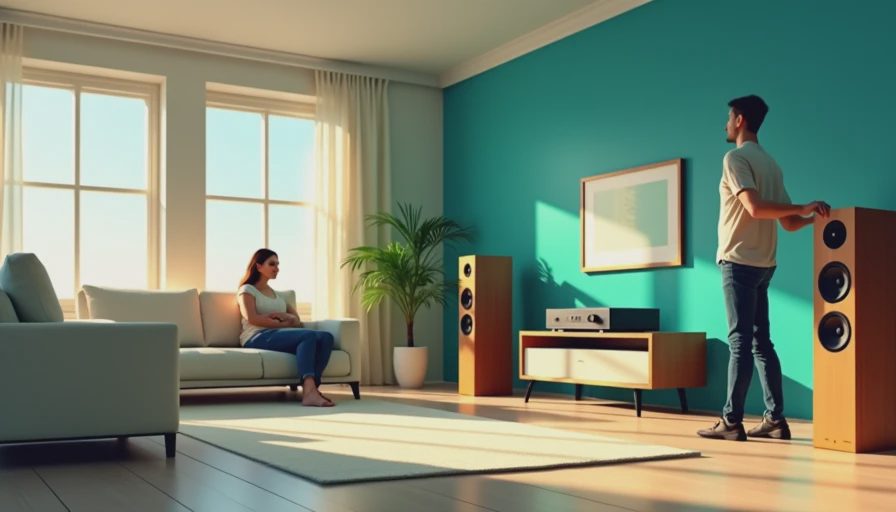
Room size changes the recommendation more than prestige does. In a 10-by-12-foot room, a large bass-heavy tower can create booming notes that no expensive cable will fix. Start with the speakers at least a foot or two from the front wall if the design permits, then move them in small increments. Place the tweeters near ear height and form an approximate triangle between your listening position and the two speakers.
Toe-in means aiming the speakers toward your ears. More toe-in can sharpen center vocals and reduce reflected treble; less toe-in can make the presentation broader and softer. Use familiar recordings: a centered vocal, an acoustic bass line, and a track with dense cymbals. If the vocal wanders or the bass changes dramatically when you move your head, placement needs work before shopping for upgrades.
Acoustic treatment is not glamorous, but two modest broadband panels at first-reflection points can help more than swapping amplifiers. A rug, curtains, and a full bookcase also reduce harsh reflections. High end speakers cannot override a hostile room, so reserve part of the budget for stands, positioning, and basic treatment.
Smart systems at different budgets
Around $1,000 to $2,000 for a pair, look for neutral bookshelf speakers from KEF, Revel, ELAC, Wharfedale, or similar established manufacturers. This range can deliver clean vocals, stable imaging, and enough bass for many rooms. A capable integrated amplifier might add $500 to $1,000, though powered options can simplify the setup.
From $3,000 to $8,000, you gain stronger cabinets, better bass drivers, lower distortion, and more output. The value becomes highly room-dependent. A pair of high end speakers from Focal, Dynaudio, Monitor Audio, or Sonus faber may sound excellent, but their tonal balance and dispersion still need to suit your space and taste.
Above $10,000, improvements become more specialized. You might get greater headroom, deeper bass, exceptional finish, or unusually controlled dispersion. Those benefits can be real, but they are not ten times more musical than a well-designed $2,000 system. Spend extra when the design solves a problem you actually have, not because a review uses more luxurious adjectives.
A practical audition checklist
Bring recordings you know, preferably uncompressed files or familiar vinyl. Listen for vocal sibilance, bass notes that blur together, and whether the tonal balance changes when you stand up or move sideways. Ask for the exact amplifier and placement used in the demonstration; a showroom system can conceal weaknesses with careful setup.
Compare levels carefully. A slightly louder speaker often sounds more impressive, even when it is not more accurate. If possible, arrange a home trial. Live with the speakers for a week at normal volume, late-night volume, and one realistic loud session. Notice whether you keep reaching for the volume control or skipping bright recordings.
Do not spend money on premium speaker cable before fixing placement. Ordinary, correctly sized cable is sufficient for normal home runs. Put the budget toward a subwoofer, stands, room treatment, or a better source instead. The best high end speakers are the ones that make you play another record, not the ones that win an argument online.
I disclose affiliate relationships clearly: links on this blog can earn me a commission at no additional cost to you. Some manufacturers send review units, but they do not control my conclusions or get approval rights. My advice remains the same whether a speaker arrived in a cardboard box or I bought it from an estate sale. Trust your ears. But measure first.


No notes yet — write the first one.