Passive speakers are still one of the smartest ways to build a serious home audio system. They do not contain a built-in amplifier, so you connect them to a separate stereo amplifier or AV receiver. That extra box sounds inconvenient until you realize it gives you more control, easier upgrades, and a wider range of speaker choices.
I spent 12 years mixing records in Nashville rooms where every part of the signal chain mattered. At home, I still prefer a system that gets the fundamentals right: accurate frequency response, sensible placement, and enough clean power. You do not need a $5,000 amplifier or exotic cable. You need passive speakers that suit your room, your listening habits, and your budget.
What passive speakers actually do
A passive speaker receives an amplified audio signal through speaker wire. Inside the cabinet, a crossover divides that signal between the woofer and tweeter. The amplifier handles the demanding electrical work, while the speaker converts the result into sound.
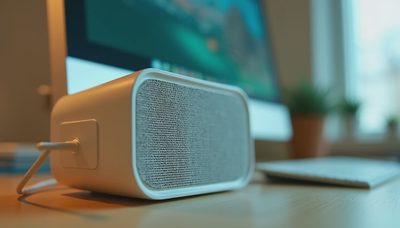
That differs from powered or active speakers, which include amplification inside the cabinet. Active models can be wonderfully convenient, especially for a desk or small apartment, but their electronics are tied to the speaker design. With passive speakers, you can replace the amplifier, add a subwoofer, or move from a compact bookshelf model to a larger floorstander without rebuilding everything.
The tradeoff is that you must match components sensibly. Look at nominal impedance, sensitivity, and the amplifier's power range. A speaker rated at 6 ohms is not automatically difficult to drive, but a low-sensitivity model in a large room benefits from a stronger amplifier. Ignore audiophile mythology and start with the specifications that affect real performance.

Bookshelf or floorstanding models?
Bookshelf passive speakers are usually the better value for a small or medium room. A pair of ELAC Debut 2.0 B6.2, Wharfedale Diamond 12.1, or Q Acoustics 3030i speakers can produce a full, convincing presentation without dominating the room. Put them on sturdy stands, with the tweeters close to ear height, and leave a little space from the rear wall.
Floorstanding passive speakers add cabinet volume and often more woofer area. Models such as the Polk Signature Elite ES60 or KEF Q750 can play louder and create deeper bass, but they need room to breathe. In a 10-by-12-foot room, a large floorstander can sound thick simply because the room reinforces low frequencies. Bigger is not automatically better; it is only better when the room and listening distance support it.
A subwoofer changes the decision. Compact bookshelf speakers crossed over around 70 or 80 Hz can sound cleaner when a capable subwoofer handles the lowest octave. That approach often beats buying oversized speakers and placing them in a corner.
Choosing the right amplifier
The amplifier is the engine of a passive system, but shopping by wattage alone is a mistake. A clean 50-watt-per-channel integrated amplifier can be excellent with efficient speakers in a normal living room. A 100-watt model gives more headroom for demanding music, larger spaces, or louder listening, but it will not magically create better detail.
For a simple setup, the Yamaha A-S301 and Cambridge Audio AXA35 are sensible starting points. The Yamaha includes useful digital inputs and a subwoofer output, while the Cambridge takes a straightforward analog-first approach. If you want streaming built in, the Yamaha R-N600A or Marantz Stereo 70s adds network features without forcing you into a full surround receiver.
Check connectivity before buying. A turntable usually needs a phono input or an external phono preamp. A television may need optical, HDMI ARC, or both. Passive speakers themselves do not decode Bluetooth, Wi-Fi, or television audio; those functions live in the amplifier or an attached source.
Trust your ears. But measure first. Frequency-response graphs, distortion measurements, and reliable impedance information will tell you more than a review filled with words such as luxurious, musical, or holographic.

Placement matters more than expensive upgrades
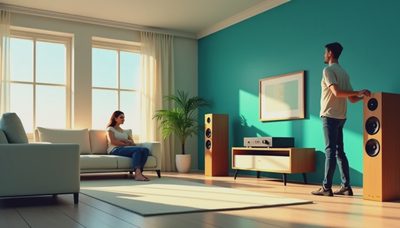
Even excellent passive speakers can sound disappointing when placed badly. Start with the two speakers forming an approximate triangle with your listening position. Aim the tweeters toward your ears, then adjust toe-in gradually. If vocals sound too sharp, reduce the angle. If the center image feels vague, aim them more directly at your chair.
Keep the speakers symmetrical relative to side walls when possible. Avoid pushing rear-ported models directly against the wall; 8 to 24 inches of space is a useful starting range. Bass changes dramatically with room boundaries, so move the speakers before buying a new amplifier or cable. A few inches can matter more than a costly accessory.
Use a familiar recording with a centered vocal, acoustic bass, and restrained percussion. A good pair should keep the vocal stable while bass notes remain distinct rather than turning into one long boom. Try recordings you know from different genres, not just an audiophile demo track designed to flatter the system.
Budget recommendations that make sense
Under $400 per pair, passive speakers such as the ELAC Debut 2.0 B5.2, Sony SS-CS5, and Polk Monitor XT20 offer strong entry points. They are not perfect: some have uneven treble or limited deep bass, but they can outperform many all-in-one systems when positioned properly.
Around $500 to $1,000 per pair, the field becomes more refined. The Wharfedale Diamond 12.2 has an easygoing balance that suits long listening sessions. The KEF Q350 offers a focused center image from its coaxial driver design. The Triangle Borea BR03 is livelier and can be a good match for listeners who want more presence in guitars and vocals.
Above $1,000, improvements become more dependent on the room and the rest of the system. Brands such as Revel, Dynaudio, Focal, and Monitor Audio make excellent models, but you should compare measurements and placement requirements rather than assuming price equals accuracy. A discounted previous-generation model can be a better buy than a fashionable new release.
Common mistakes to avoid
Do not spend most of your budget on speaker wire. Use correctly gauged copper cable, make secure connections, and move on. Do not run an amplifier into clipping because a small speaker is being asked to fill a huge room. Clipping can damage tweeters, and the sound becomes harsh long before you reach a satisfying volume.
Also avoid choosing passive speakers solely because a reviewer calls them warm or detailed. Warm usually means a slightly relaxed treble or stronger lower midrange. Bright often means elevated upper-midrange or treble energy. Those descriptions are useful only when connected to measurements and your room. If you listen for several hours, a smooth response may matter more than an exciting first five minutes.
Finally, do not forget the listening position. Sitting against a wall can exaggerate bass, while sitting far off to one side can destroy stereo balance. Before replacing components, adjust the room, stands, toe-in, and distance from boundaries.
A well-matched pair of passive speakers can serve through multiple amplifier upgrades and changing sources. Start with honest measurements, buy from a retailer with a practical return policy, and audition familiar music at moderate volume. That is how you get a system that sounds good on Tuesday night, not just during a showroom demonstration.
Disclosure: Some links on this blog may be affiliate links, which means I can earn a commission if you buy through them. Review units, when provided, do not guarantee a positive opinion.


No notes yet — write the first one.