Can studio monitors as hi-fi speakers make your records, streams, and movies sound better? Absolutely, but not simply because they carry the word studio. A good monitor is designed to reveal problems in audio, while a good home speaker often aims for a particular flavor. Those goals can overlap, and when they do, you get clear, balanced sound for less money than many traditional audiophile systems.
I spent 12 years mixing records in Nashville rooms filled with Yamaha, Genelec, ATC, and other professional monitors. The useful lesson was never that one brand had magical ears built into it. It was that frequency response, distortion, placement, and room interaction mattered more than prestige. Studio monitors as hi-fi work best when you understand those basics before buying.
What makes a studio monitor different?
Most studio monitors are active speakers. That means each cabinet contains one or more amplifiers, along with an electronic crossover that sends bass, midrange, and treble to the appropriate driver. You do not need a separate power amplifier, and the amplifier is matched to the speaker from the factory. Connect a source with the correct cable, adjust the gain, and you are ready to listen.
Passive hi-fi speakers, by contrast, need an external amplifier or receiver. That setup gives you more freedom to mix brands, but it also adds cost and another place for poor design or mismatched power to affect the result. A pair of active monitors priced around $300 to $700 can compete with a passive speaker and amplifier combination costing $800 to $1,500.
The typical monitor is also tuned for a relatively neutral response. In plain English, neutral means the speaker does not intentionally make the bass, vocals, or treble much louder than they were in the recording. That does not guarantee a pleasant experience. A badly placed neutral speaker can sound thin, sharp, or boomy. It does give you a more honest starting point.
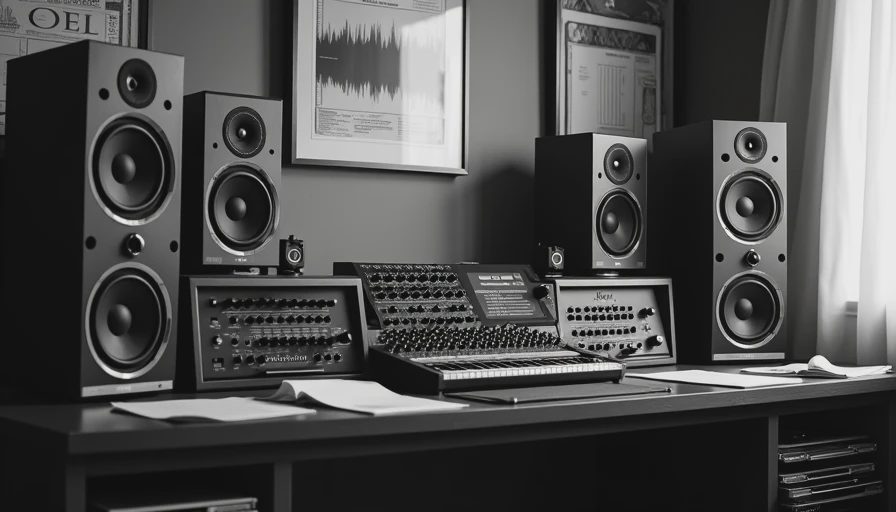
The best studio monitors as hi-fi options for real rooms
The Yamaha HS5 remains a familiar recommendation because its midrange is clear and its measurements are well understood. However, its five-inch woofer does not produce deep bass at high levels, and its treble can sound forward in a reflective room. The HS7 adds bass and headroom, but it also needs more space from nearby walls.
The JBL 305P MkII is one of the strongest budget choices. Its waveguide helps control the upper frequencies, and the speaker can produce a wide listening area for roughly $300 per pair when discounted. It is not luxurious, and the rear-panel controls are basic, but it gives music a clean tonal balance without demanding a large investment.
For a smaller desk or bedroom, the Kali Audio LP-6 V2 is worth serious attention. It offers useful boundary controls, a larger woofer than many entry-level models, and enough output for normal living-room listening. The Adam Audio T5V adds an air-motion transformer tweeter and a lively top end. Some listeners enjoy that extra presence; others will find it too energetic near bare walls.
At a higher price, Genelec monitors such as the 8030 series bring excellent build quality, low distortion, and dependable consistency. They are superb, but a $1,000-plus pair cannot overcome a poor room or careless setup. Spend on placement and basic acoustic treatment before assuming the expensive option is automatically better.
Placement matters more than the logo
Put the left and right speakers the same distance from your listening position, forming an approximate equilateral triangle. The tweeters should sit near ear height and point toward your ears. Keep both cabinets on stable stands or isolation pads, rather than letting them sit directly on a hollow desk that can vibrate.
Start with the monitors 12 to 24 inches from the front wall, then listen for changes in bass. A corner usually reinforces low frequencies and can make a kick drum or bass guitar sound oversized. If your monitor has low-frequency and high-frequency trim switches, use them to make small corrections after positioning, not as a substitute for positioning.
A rug, curtains, bookshelves, and upholstered furniture can reduce harsh reflections. You do not need to cover every wall with foam. Two or four broadband panels at the first reflection points can be more useful than decorative egg-crate foam spread randomly around the room.
Studio monitors as hi-fi are especially convincing in a nearfield setup, where you sit three to five feet away. The direct sound reaches your ears before as many room reflections build up, so the tonal balance becomes easier to hear. This is one reason a modest $350 pair can outperform a much larger system placed badly across a living room.

Connecting monitors to your home audio system
The simplest source is a computer, streamer, or phone connected to a compact audio interface or digital-to-analog converter. Choose a device with balanced TRS or XLR outputs when possible. Balanced connections reject electrical noise over longer cable runs, though they do not make music sound magically more detailed. A short, properly working unbalanced connection is also fine in many homes.
For a television, an optical output feeding a small DAC is often cleaner than using a headphone jack. Some monitors include a volume control, but many do not. A monitor controller, DAC with a physical volume knob, or preamp gives you safer, easier control. Keep the monitor gain at a sensible level and make changes gradually; a misadjusted volume knob can produce an unpleasant blast.
If you already own a Marantz, Pioneer, or Sansui receiver, do not connect its amplified speaker outputs to powered monitors. That can damage the input stage. Use a line-level output intended for recording or a proper converter, and read the manual before making assumptions about the jacks.
Where studio monitors as hi-fi can disappoint
A monitor may be less convenient than a conventional wireless speaker. Many models lack Bluetooth, remote volume control, automatic standby that works reliably, or a subwoofer output. You may need extra equipment for streaming, television integration, and switching between sources. The speaker itself can be inexpensive while the complete system becomes less simple.
Some monitors also reveal aggressive mastering, damaged vinyl pressings, and poor streaming files. That honesty is useful when mixing, but it is not always relaxing after a long workday. If you prefer a warmer presentation, a speaker with a gentle treble roll-off or a small bass lift may suit you better. Studio monitors as hi-fi do not need to be a moral choice; they are one tool among several.
Bass is another practical limit. A five-inch monitor can sound tight and articulate without reproducing the lowest organ notes or cinematic effects with authority. Adding a subwoofer helps, but integration requires level, crossover, and placement adjustments. In a small room, fixing a bass peak can matter more than buying a larger subwoofer.
A sensible buying process
First, measure your desk or room and decide whether nearfield listening is realistic. Next, set a total budget that includes stands, cables, a DAC or interface, and possible isolation pads. At $350, the JBL 305P MkII or a discounted entry-level Kali system makes sense. Around $500 to $800, compare the Kali LP-6 V2, Yamaha HS7, and Adam T7V according to room size and tonal preference. Above that, prioritize lower distortion, useful room controls, and construction quality rather than exotic claims.
Use familiar recordings with natural vocals, acoustic bass, cymbals, and dense mixes. Listen at moderate volume for several days. A speaker that sounds impressive for five minutes can become tiring if its treble is exaggerated. Pay attention to whether voices sound natural, bass notes remain distinct, and cymbals have texture rather than a constant hiss.
My short answer is yes: studio monitors as hi-fi can be an excellent choice for listeners who value accuracy, compact systems, and sensible pricing. Buy based on measurements and room fit, not the most dramatic product description. Trust your ears. But measure first.
This article reflects my own listening and engineering experience. Some product links on this blog may be affiliate links, which means I can earn a commission without changing your price. Review units, when provided, are identified in the individual review, and manufacturers do not control my conclusions.


No notes yet — write the first one.