Floor standing speakers can deliver a bigger, fuller presentation than bookshelf models, but size alone does not guarantee good sound. I have heard impressive towers that disappear into a mix and expensive ones that turn every cymbal into a dental drill. After 12 years mixing records in Nashville studios, I look for controlled frequency response, sensible distortion figures, useful bass extension, and a design that works in an actual living room. The goal is not to buy the largest cabinet. It is to buy the most honest, enjoyable speaker your room and amplifier can support.
Why floor standing speakers make sense
A tower speaker gives you more cabinet volume and usually more driver area. That can mean deeper bass, higher output, and less strain when you play orchestral music, rock, or a movie soundtrack at realistic levels. You also avoid the cost and floor space of separate speaker stands. A good pair of floor standing speakers can be a particularly clean solution for a two-channel system with a turntable, integrated amplifier, and streaming source.
The tradeoff is room interaction. Bigger cabinets excite more low-frequency energy, and that energy can pile up near walls and corners. A speaker that sounds tight in a dealer showroom might produce a boomy 60-hertz note in a small apartment. That is not necessarily a defective product; it is the room responding to the speaker. Placement, listening distance, and basic acoustic treatment matter as much as the logo on the grille.
Look at the intended listening distance, too. A compact tower such as the ELAC Debut 2.0 F6.2 suits many modest rooms, while a larger model such as the KEF R7 Meta needs more space to breathe and costs considerably more. The expensive option is not automatically the better match.
What to evaluate before buying
Start with frequency response. In plain English, this describes how evenly a speaker reproduces bass, midrange, and treble. A broad, smooth response is usually easier to live with than a dramatic treble boost designed to sound exciting for ten minutes. Bright means elevated upper frequencies; it can make detail seem impressive at first and fatiguing later. A dip in the midrange can make vocals sound distant, while excessive bass can blur kick drums and bass guitar.
Measurements are not the whole story, but they expose useful problems. Check independent tests for on-axis and listening-window response, distortion, and impedance. Low distortion is especially valuable in the midrange, where voices and guitars live. Impedance tells you how demanding the load is for an amplifier. A nominal 8-ohm rating does not guarantee an easy load, so look for a minimum impedance figure when available.
Sensitivity is another practical specification. A speaker rated around 88 decibels will generally play louder from the same amplifier than one rated around 84 decibels. That does not make it better; it simply affects amplifier requirements. For many homes, a 50- to 100-watt-per-channel integrated amplifier is plenty. Do not spend $1,500 on a boutique power cable before confirming that your amplifier has adequate current and your speakers are positioned correctly.
Floor standing speakers at different budgets
At the affordable end, the Polk Audio Reserve R500 and ELAC Debut Reference DFR52 are sensible places to investigate. They offer real bass capability without requiring a separate subwoofer immediately, though their voicing and cabinet proportions differ. The Klipsch RP-8000F II can play loudly with modest amplifier power, but its lively treble is not ideal for every room or listener. If you are sensitive to bright recordings, listen before committing.
The midrange includes models such as the Wharfedale EVO4.4, Q Acoustics 5040, and Monitor Audio Silver 300. These speakers occupy different design philosophies, so a price comparison is less useful than a direct listen with familiar music. A well-recorded acoustic track should keep the vocal centered and natural. Dense rock should remain organized when the drummer and bass player enter together. A piano should have weight without turning every hammer strike into a sharp click.
At the premium end, brands including KEF, Revel, Focal, and Bowers & Wilkins offer sophisticated cabinets and drivers, but the upgrade is not magic. Better materials can reduce resonances and distortion, yet a $2,000 pair in a poorly treated room can sound worse than an $800 pair placed carefully. Spend on the whole system, not just the most visible component.
Placement is free performance
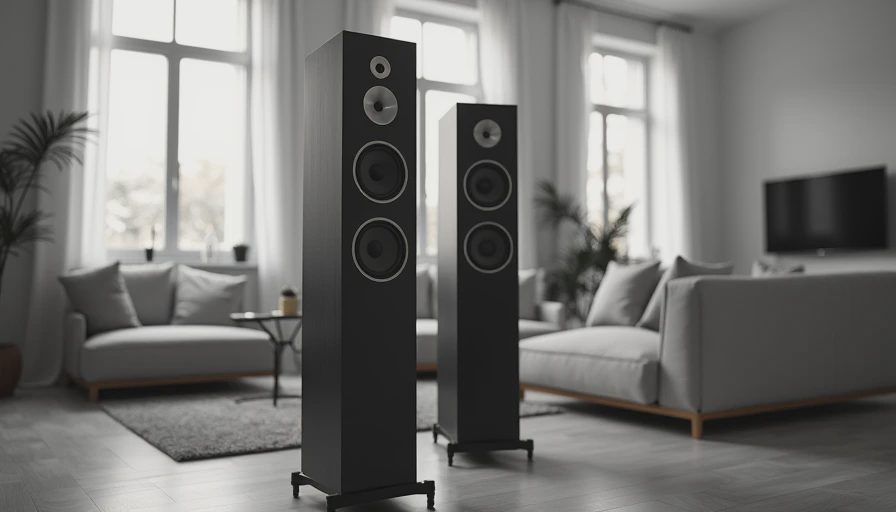
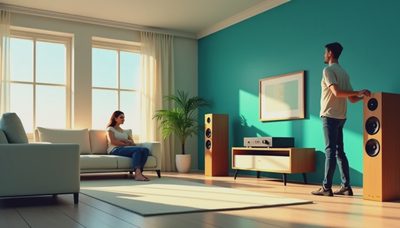
Begin with the speakers on the same wall, forming an approximate equilateral triangle with your listening position. If the towers are eight feet apart, sit roughly eight feet from each one. Keep them at least 12 to 24 inches from the front wall as a starting point, then move them in small increments. Pulling them farther out often tightens bass; moving them closer can add warmth but also boom.
Toe-in means angling each speaker toward your seat. Start with the tweeters aimed directly at you, then reduce the angle if vocals sound too concentrated or treble feels intense. Keep the tweeters near ear height when seated. Use a tape measure for symmetry, because a difference of several inches can shift the center image. If one speaker is near a side wall and the other is open to the room, equal spacing may be impossible; modest toe-in and room correction can help.
Do not automatically add foam panels everywhere. First address strong reflections with a rug, curtains, a full bookcase, or strategically placed broadband panels. Bass traps are more useful than thin decorative foam for low-frequency problems. Your phone can provide a rough measurement, while a calibrated USB microphone and Room EQ Wizard offer a much clearer picture.
Matching an amplifier and source
Most modern floor standing speakers work with ordinary integrated amplifiers. Yamaha, Marantz, Cambridge Audio, NAD, and Onkyo all make competent options across different price ranges. Choose based on power into the speaker's real impedance, useful connections, and listening habits. If you stream, an amplifier with reliable network support or a separate WiiM streamer may be more practical than an expensive DAC whose audible benefits are difficult to identify.
A turntable needs a phono stage, either built into the amplifier or supplied separately. Keep the cartridge aligned, the tracking force correct, and the records clean. Those steps produce a larger improvement than swapping a one-meter interconnect. I have restored enough vintage Marantz and Pioneer amplifiers to appreciate their character, but an old receiver still needs safe capacitors, clean controls, and a healthy output stage.
For a large room or bass-heavy movie use, a subwoofer can extend the lowest octave and reduce the load on the main speakers. It is not mandatory. A well-designed tower already reaches low enough for many music systems, and adding a poorly integrated sub can make the result worse.
A practical audition checklist
Bring three or four familiar tracks rather than relying on a store playlist. Use a vocal recording to judge midrange balance, a simple bass line to hear pitch definition, and a dense track to test congestion. Listen at low volume first. If the tonal balance falls apart quietly, louder playback will not fix it. Then raise the level briefly and notice whether vocals harden, cymbals become aggressive, or bass loses control.
Compare at matched volume. The louder speaker nearly always sounds more impressive, even when it is less accurate. Ask whether you can identify instruments clearly, whether voices sound human, and whether you would enjoy an entire album rather than one impressive excerpt. If possible, arrange a home trial and leave the speakers in place for several days. Familiarity reveals fatigue that a 15-minute showroom session can hide.
The best floor standing speakers are not necessarily the biggest, most expensive, or most heavily marketed. They are the ones that suit your room, amplifier, music, and tolerance for tonal color. Measure first, position carefully, then trust your ears. That combination beats forum mythology every time.
I may earn a commission from links to products I recommend, and some review units are supplied by manufacturers. Neither changes my measurements or conclusions. Trust your ears. But measure first.



No notes yet — write the first one.