Studio monitors are built to reveal what is actually in a recording, not simply to make every song sound bigger or warmer. After 12 years mixing records in Nashville, I still think the right pair is one of the smartest upgrades for a desktop system, home studio, or serious music room. You do not need a $5,000 budget, golden ears, or a shelf full of exotic cables. You need speakers with a reasonably balanced response, enough clean output for your room, and careful placement.
The phrase “studio” can sound intimidating, but the basic idea is simple. A good speaker should let you hear bass, midrange, and treble without one part shouting over the others. That makes it easier to spot a muddy kick drum, harsh vocal, or clipped podcast edit. The same honesty is useful when you are streaming an album, watching a movie, or digitizing vinyl.
What studio monitors actually do
Most studio monitors are active speakers, meaning each cabinet has its own amplifier. You connect an audio interface, mixer, computer DAC, or another line-level source directly to the inputs on the back. This removes the need to match a separate amplifier to the speakers, although it does not remove the need for a decent signal source.
The important specifications are frequency response, maximum output, distortion, input options, and room controls. Frequency response describes how evenly the speaker reproduces different pitches. A monitor that boosts the upper treble can sound exciting for five minutes but tiring over a full album. A monitor with too much upper bass can make a mix seem full while hiding problems that appear on headphones or a car stereo.
Do not treat published frequency ranges as magic. A claim such as 38 Hz to 20 kHz says very little without tolerance figures. A range measured at plus or minus 10 decibels is not comparable to one measured at plus or minus 3 decibels. Measurements from reliable independent reviews are more useful than a dramatic number printed on a box.
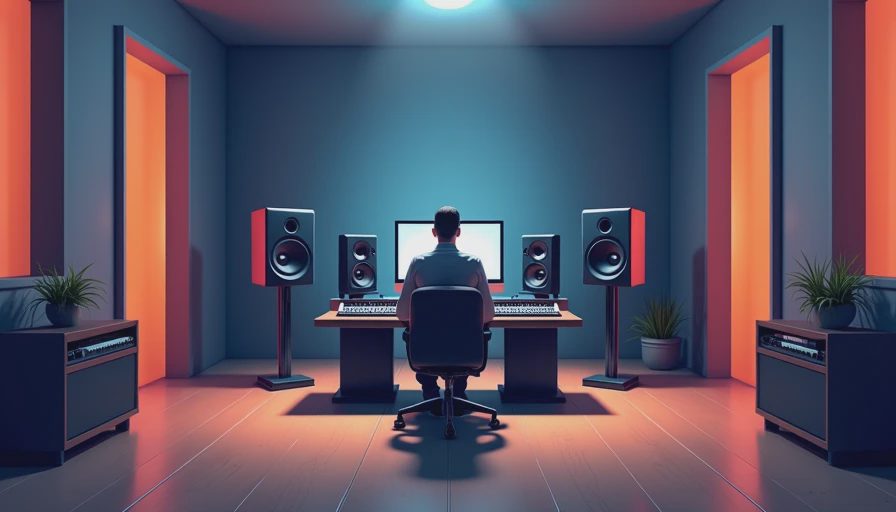
How to choose studio monitors for your room
Start with room size and listening distance, not prestige. In a small bedroom or office, a five-inch woofer is often the sensible choice. Models such as the Yamaha HS5, JBL 305P MkII, Kali Audio LP-6 V2, and Adam Audio T5V can produce a clear nearfield presentation without demanding a huge room. Nearfield means you sit relatively close to the speakers, so direct sound reaches your ears before the room reflections become overwhelming.
A larger woofer is not automatically better. An eight-inch speaker can move more air and reach deeper bass, but that extra energy can excite room modes. You may hear one low note booming at the listening position while another nearly disappears. That is a room problem, not proof that the speaker is defective. In an apartment, a controlled five- or six-inch model is usually easier to live with than a powerful eight-inch pair.
Think about connections too. Balanced XLR or TRS inputs help reject electrical noise over longer cable runs, while RCA inputs are convenient for consumer gear. Many models include high- and low-frequency trim controls. These switches are useful when a desk or wall makes the sound too bright or bass-heavy, but they cannot fix a severe acoustic problem.
Best studio monitors at different budgets
For an affordable starting point, the JBL 305P MkII remains easy to recommend when its sale price lands around $300 to $400 per pair. Its wide dispersion makes the listening area forgiving, and its rear controls help with basic placement issues. The tradeoff is a noticeable hiss from some units at close range and a cabinet that feels utilitarian rather than luxurious.
The Yamaha HS5, often priced near $400 to $500 per pair, has a forward midrange that can expose vocal and guitar problems. That honesty is valuable for editing and mixing, though it is not the most relaxing choice for casual listening. If you want deeper bass from the same general family, the HS7 is more capable, but give it more space from walls and corners.
Kali Audio’s LP-6 V2 is a particularly strong value when available around $400 to $500 per pair. It offers useful boundary controls and fuller low-end extension than many five-inch competitors. Adam Audio’s T5V, commonly found near $400 to $500 per pair, adds an air-motion tweeter with a distinct treble character. “Airy” here means more energy in the upper frequencies, not some mystical extra dimension. If your recordings already sound bright, audition carefully.
At a higher price, Genelec, Neumann, and Focal offer excellent options, but diminishing returns arrive quickly. A $1,500 pair in a poor room will not outperform a $400 pair positioned well in a treated one. Spend first on placement, stands, and basic acoustic control.

Positioning studio monitors correctly
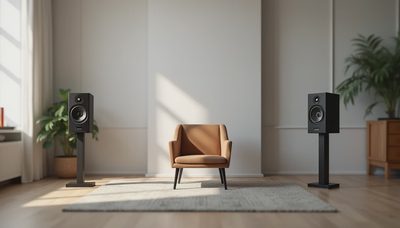
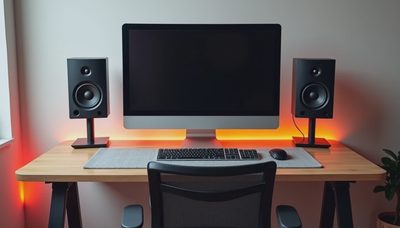
Place the speakers and your head as an approximate equilateral triangle. The tweeters should point toward your ears, and both cabinets should be the same distance from the side walls. Put the tweeters near ear height, then angle the cabinets inward until their axes meet around your listening position. This improves stereo imaging, meaning the placement of sounds from left to right.
Keep the front of the cabinets away from the wall when the manufacturer recommends it, but do not obsess over a universal distance. Boundary reinforcement changes the bass response, and every room behaves differently. If the low end is thick, move the speakers forward, use their rear trim controls, or address the room with bass trapping. Do not buy expensive isolation pucks expecting them to cure a 50 Hz mode.
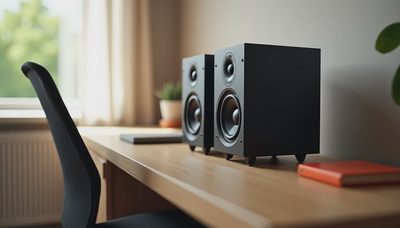
A desk can also cause trouble. Reflections from a hard desktop arrive shortly after the direct sound and can make the midrange less clear. Stands behind or beside the desk are often more effective than placing the speakers flat on the work surface. Measure distances with a tape, then listen to familiar recordings at a moderate volume.
Do studio monitors work for everyday listening?
Absolutely, provided you enjoy accurate sound. Studio monitors do not have to be cold, sterile, or unpleasant. They simply avoid adding as much coloration as many lifestyle speakers. Well-recorded jazz, rock, electronic music, and spoken voice can sound more open because details are not being masked by an exaggerated bass hump.
The downside is that poor recordings stay poor. A compressed master, harsh cymbal mix, or damaged vinyl transfer will not receive a flattering makeover. For some listeners, that honesty is the point; for others, a warmer consumer speaker is a better match. There is no moral prize for choosing the flatter response.
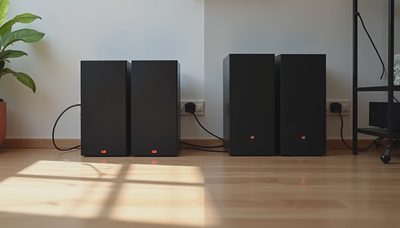
Also remember that active speakers need power and cables at each cabinet. A surge protector and sensible cable management are worthwhile. You do not need premium interconnects. A properly made balanced cable costing $15 to $30 can perform the job as well as a luxury cable costing ten times more.
A practical buying checklist
Before ordering, measure the room and decide how far you will sit from the speakers. Choose a woofer size that suits that distance, confirm the input type on your interface, and check whether the rear-panel controls address your placement. Read measurements from a credible source, but use them as a starting point rather than a substitute for listening.
If possible, buy from a retailer with a reasonable return policy. Play familiar tracks containing natural vocals, acoustic bass, dense guitars, and restrained high hats. Listen for tonal balance at low and moderate volume. If the speakers make you turn down within ten minutes, the treble may be too aggressive for your room. If every kick drum becomes a blur, look for bass buildup before blaming the mix.
My short list for many beginners is the JBL 305P MkII, Kali LP-6 V2, Yamaha HS5, or Adam T5V, depending on room size and taste. Trust your ears. But measure first.
Disclosure: Some links on this site may be affiliate links, which means I can earn a commission if you buy through them, at no additional cost to you. Review units may also be supplied by manufacturers; editorial opinions remain my own.
No notes yet — write the first one.