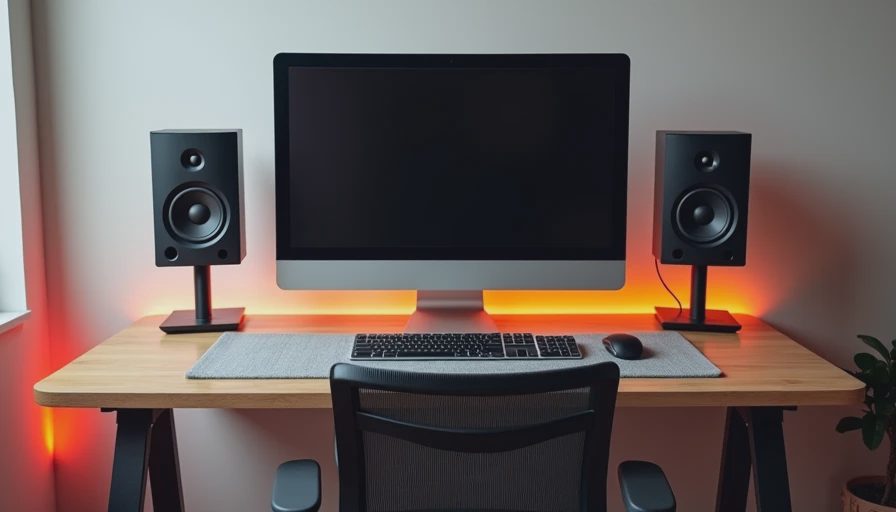
The Most Underrated Listening Setup in the House
Most people think serious listening requires a big room, big speakers, and a dedicated chair in the perfect sweet spot. That setup is great when you have it. A lot of us spend more hours at a desk than in a living-room listening seat.
Nearfield listening—speakers close to you, usually on or just behind a desk—can be more revealing and more consistent than a poorly treated larger room. I’ve mixed and checked records on nearfields for years. The same principles that make a studio desk work also make a home workstation sound a lot better than most people expect.
You don’t need to turn your office into a control room. You need correct distance, sensible height, controlled reflections, and speakers that are suited to the job.
What Nearfield Actually Means
Nearfield means the speakers are close enough that the direct sound reaches your ears significantly louder than the early reflections from the room. In practice this is usually 3 to 5 feet (about 90–150 cm) from your ears to each speaker.
At that distance several helpful things happen:
The room has less time and less level to mess with the sound before it reaches you
Small speakers can play loudly enough without strain
Imaging becomes more precise because the left and right signals arrive with less interference
You can make reliable judgments about balance, EQ, and detail
The trade-off is that the setup is optimized for one primary seat. Move a few feet left or right and the image and tonal balance shift. For a desk that is usually fine—you sit in the same place anyway.
The Geometry That Makes or Breaks a Desk Setup
Get these relationships right before you buy anything else:
Form the triangle. The distance between the two speakers should roughly equal the distance from each speaker to your ears. This is the same equilateral-triangle starting point used in larger rooms. At a desk it is easier to measure and easier to maintain.
Height. Tweeters should be close to ear level when you are sitting in your normal posture. Too low and the desk reflection gets worse while the treble softens. Too high and the balance tilts the other way. Small stands, isolation platforms, or even sturdy books can solve this.
Distance from the wall behind the speakers. Even in nearfield, boundary reinforcement still exists. Pulling the speakers 6–12 inches forward from the wall (or from a monitor riser hard against the wall) usually tightens the bass and clears the lower midrange.
Symmetry. The left and right sides of the desk should be as similar as possible. A tall monitor or stack of gear on one side only will pull the image and color the sound.
Dealing With the Desk Reflection
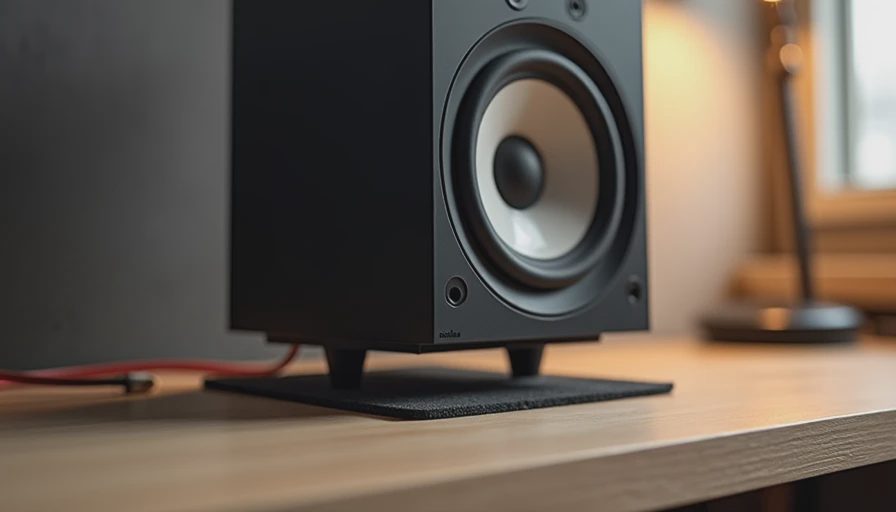
The single biggest acoustic problem on most desks is the hard surface right in front of and between the speakers. Sound leaves the speaker, hits the desk, and arrives at your ears a fraction of a second later. That reflection can create comb filtering—peaks and dips in the midrange that make voices and instruments sound hollow or harsh.
Practical fixes, ranked from easiest to more involved:
Pull the speakers forward to the front edge of the desk so more of the sound travels directly to you
Raise the speakers on short stands or isolation pads to change the reflection angle
Place a small absorption panel, thick mousepad zone, or even a folded towel in the center of the desk between the speakers (surprisingly effective)
Use a desk mat that covers more of the reflective surface
You do not need perfect absorption. You need to reduce the strength of that first hard reflection.
Speaker Choice for Nearfield
Not every speaker is happy at close range. Look for:
Controlled directivity so the sound does not change drastically the moment you move your head
A clean midrange that does not become aggressive at short distances
Enough output and low-distortion capability to reach satisfying levels without the drivers working too hard
Optional boundary or desk-compensation switches (common on many active monitors)
Active speakers are especially convenient here. Matched amplification, compact size, and often useful DSP or EQ make them natural nearfield tools. Passive speakers can work well too if the amp is clean and the sensitivity matches your listening levels.
A Simple Nearfield Setup Sequence
Place the speakers so they form an equilateral triangle with your head.
Adjust height until the tweeters are at ear level.
Pull them forward or add height to reduce the desk reflection.
Set a moderate listening volume and play a track with steady vocals and clear stereo information.
Toe the speakers in until the center image locks and the treble sounds natural rather than dull or etched.
Check the bass with a couple of tracks that have consistent low-end content. Move the speakers an inch or two closer to or farther from the wall if the bass feels bloated or thin.
Sit in your normal posture and listen for a full song without adjusting anything. Then make only one change at a time.
Small, deliberate moves beat large random ones.
What a Good Desk Setup Can and Cannot Do
It can:
Give you reliable, repeatable sound for both enjoyment and critical listening
Reveal detail and balance problems that disappear in a more reverberant room
Stay consistent day after day because the geometry rarely changes
It cannot:
Create the same physical scale and bass extension as a well-set-up pair of larger speakers in a bigger room
Sound equally good to someone standing behind you or sitting on the couch
Fix fundamentally colored or distorted speakers
Nearfield is a precision tool for one seat. Use it that way.
The Bottom Line
Your desk is already the place you spend hours. With correct distances, ear-level height, basic reflection control, and speakers that behave well at short range, it can become one of the most honest listening environments in the house.
You don’t need a dedicated studio. You need geometry, a little absorption or clever placement to tame the desk, and the willingness to measure with your ears (and a tape measure).
Trust your ears. But measure first.
Then sit down, hit play, and notice how much cleaner and more stable everything becomes when the speakers and the desk are finally working together instead of against each other.
No notes yet — write the first one.